Showing posts with label historical fiction. Show all posts

Monday, September 28, 2020

The Lady's Guide to Petticoates and Piracy by Mackenzi Lee

 The Lady's Guide to Petticoats and Piracy (Montague Siblings, #2) Felicity Montague wants to be a doctor more than anything in the world. Medicine is her one true love. Alas, Felicity is a woman in 1700s (I'm not completely sure of the time period) England and Scotland. It is a time when many men don't think medicine, outside of herbal practices and midwifery, is a suitable job for a woman. Felicity tries to plead her case to numerous doctors and hospitals. She's read all the medical texts could get her hands on. She has reattached a man's finger and mended broken men in the field of battle. Despite her passion and obvious intellect, none of the doctors or hospitals will take her on as a student.

Felicity hopes that she has finally found a way in. Johanna, a childhood friend is engaged to marry Dr. Platt, Felicity's idol. Felicity decides to crash the wedding and plead her case to Platt. Unfortunately, Platt is a let down. Not just because he, like so many of the other men in the story, can't conceive of a woman being a doctor, but because he has nefarious motives of his own in marrying Johanna. Felicity pushes forward and finds her tribe of sorts in the form of two other smart, ambitious women, Johanna and Sim. Together the three of them go on a wild adventure that takes them to Germany and the Barbary Coast.

The Lady's Guide to Petticoats and Piracy is the second in the Montague Siblings series. I enjoyed the first book, The Gentleman's Guide to Vice and Virtue but this one was even better. It was full of adventure, sometimes involving petticoats and dragons! It was messy and gross they way I imagine life actually was during this time period. (The streets are literally filed with mud and decomposing animal parts. Very few baths seem to have been taken during this time period.) There is never an easy path for Felicity, at least not any that she wants, and I appreciated that because that's real. No man comes and saves her and says, yes, I'll let you be a doctor. There's also a bit of interesting comments about race. At one point Felicity finds herself in the minority - she's the only one (or very few) white woman in a group of Africans and she feels very alone. Felicity  realizes how Sim (who hails from the Barbary Coast) must feel most of the time. Another time Felicity catches herself when they meet another African woman and Felicity assumes that the woman and Sim must be related simply because they are both African.

I enjoyed the reading the author's notes almost as much as I enjoyed the story itself. Mackenzi Lee's story isn't just wishful thinking. Turns out there were women who pioneered in medicine, naturalism, and piracy. Some of these women were inspirations for the characters in the story. I'm excited for the next book in the series, though I can't imagine it will match up to this one.

Tuesday, September 22, 2020

The Water Dancer by Ta-Nehisi Coates

The Water Dancer   This was a long and arduous read. It’s not that I didn’t like it. It is quite good. The writing is beautifully, truly beautiful. There’s an honesty about the brutality of slavery and all those involved (included abolitionists) that I haven’t seen in many books on the subject. Still, it is about slavery and right now I could do with fewer reminders of Black people being terrorized and murdered.

A few passages that I liked:

Bored whites were barbarian whites. While they played at aristocrats, we were their well-appointed and stoic attendants. But when they tired of dignity, the bottom fell out. New games were anointed and we were but pieces on the board. It was terrifying. (page 27)

The Underground would give me no chance to reconsider, for though we all dreamed of going north, all sorts of fears might overrun a man when the dream descended into the real. There is always a part of us that does not want to win, wants to stay down in the low and familiar. (page 185)

Corrine Quinn was among the most fanatical agents I ever encountered on the Underground. All of these fanatics were white. They took slavery as a personal insult or affront, a stain upon their name. They had seen women carried off to fancy, or watched as a father was stripped and beaten in front of his child, or seen whole families pinned like hogs into rail-cars, steam-boats, and jails. Slavery humiliated them, because it offended a basic sense of goodness that they believed themselves to possess. And when their cousins perpetrated the base practice, it served to remind them how easily they might to de the same. They scorned their barbaric brethren, but they were brethren all the same. So their opposition was a kind of vanity, a hatred of slavery that far outranked any love of the slave. (pages 370-371)


Thursday, May 14, 2020

The Gentleman's Guide to Vice and Virtue by Mackenzi Lee

The Gentleman's Guide to Vice and Virtue (Montague Siblings, #1)  Henry "Monty" Montague has been bred to be gentleman but would rather spend his time gambling, drinking, and shall we say hooking up with women and men. His father gives him one last chance. Monty is sent on a grand tour (think of it as a gap year for the 18th century set) of continental Europe. In addition to a chaperone, Monty is accompanied by his best friend and romantic crush Percy and his sister Felicity. The plan is that after a year touring around the continent Percy will be dropped off at a school in Holland (or so Monty is told) and Felicity will be left at a finishing school. 

Monty is a rich, white, spoiled boy who just wants to have fun and has no interest in becoming the next earl and running his father's estate. One of the things I loved about this is that Monty is called out for his privilege but not in a mean way. Percy is Black. Okay, technically he's biracial man born and raised in England but almost everyone assumes he's from Africa or that he is Monty's property. When Monty chastises Percy for not standing up himself when yet another person comments on his Blackness, Percy points out that he cannot afford to get away with the antics Monty regularly engages in. Likewise, when Monty complains about his planned future Felicity reminds him that at least he has choices while she has few. She would love to attend the school her brother got kicked out of, but because she is a woman finishing school is the only education Felicity's father will allow. At the same time Percy and Felicity don't dismiss Monty's complaints. They point out Monty's privileged life and status while still respecting and supporting his desire to live a different life than the one set out by his father. I love that.

Did I mention that the grand tour turns into a great adventure! Monty being Monty causes a bit of trouble at a party. Nudity and hijinks are involved. The bit of trouble leads to big trouble and even bigger adventures. The traveling companions have to hold their own against highwayman and robbers while also dealing with matters of the heart. Their adventures lead them to Barcelona, Venice, and the high seas. If you like a bit of adventure this is well worth the read.

Thursday, May 16, 2019

A Conspiracy in Belgravia by Sherry Thomas

A Conspiracy in Belgravia (Lady Sherlock, #2) 
Charlotte is living mostly happily in exile form her family after the events from the first book. Her sister Livia is less lucky, still having to trudge through the (mating) season that is part and parcel of being an unmarried young woman in Victorian England. When not working on a way to help Livia and their other sister Bernadette, Charlotte is solving mysteries. After advertising his/her services for cases big and small, a Mrs. Finch shows up asking for Sherlock’s help in finding her first love. Sherlock immediately sees through Mrs. Finch’s ruse and recognizes her as Lady Ingram, the wife of one of Charlotte’s closest friends. Alas, Mrs. Finch/Lady Ingram is not the only one pretending to be someone she is not. 

I must admit to finding the plot slightly confusing. There was a dead body, Moriarty or at least people connected to Moriarty, and people pretending to be someone else. At various points I forgot what mystery Sherlock was trying to solve. Nevertheless, this was a fun and intriguing read. Lady Sherlock is the best Sherlock. In some renditions Sherlock is little more than a stock character with lots of annoying quirks that people put up with because he’s brilliant. Ms. Thomas makes her Holmes feel as if she could be a real person.

One of things I enjoyed most about A Conspiracy in Belgravia (and in the first book in the series, A Study in Scarlet) is how Ms. Thomas infuses the politics of being a woman in Victorian England into the story in a meaningful ways. One of those meaningful ways here takes the form of Inspector Treadles and his wife. Treadles admits that the learning Sherlock’s true gender identity was a shock. He is even more troubled when he realizes that at one time his wife had ambitions other than being a wife. He wonders why she must “desire power and unwomanly accomplishments."

It is such a treat to discover a new series and a new author. I am so glad Sherry Thomas is writing the Lady Sherlock series and that I get to read it.

Friday, July 21, 2017

Cocaine Blues by Kerry Greenwood

Cocaine Blues (Phryne Fisher, #1)  Cocaine Blues is a mystery set in in late 1920s/ early 1930s Australia (so maybe it is a historical mystery). Phryne (pronounced fry-knee) was born poor in Australia. Thanks to the Great War several people in Phryne's extended family die, resulting in Phryne's father elevation to a title and wealth. And just like that, Phryne and her family are removed to London. Now an adult, Phryne has grown bored with flower arranging and whatever else wealthy women do with their time. When family friends ask her to check on their daughter back in Australia, Phryne welcomes the change of scenery.
Within hours of setting foot in Melbourne, Phryne stops a woman from stabbing the man who wronged her. From there Phryne finds herself involved in one mystery after another. She uncovers the identity of an illegal abortionist who has been butchering women, breaks up a cocaine ring, and enjoys the company of handsome Russian dancer. She is intelligent, fearless, and always fabulously dressed. Cocaine Blues is the first in a series with dozens of volumes, which means plenty more adventures for Phryne Fisher, lady detective.

Saturday, March 4, 2017

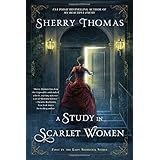
A Study in Scarlet Women by Sherry Thomas

Product Details My Sherlock Homes themed reading series continues with A Study in Scarlet Women by Sherry Thomas. It is the first in a new series dubbed The Lady Sherlock series. In this first book readers get an origin story as to how Charlotte Holmes, youngest of Lord and Lady Holmes's four daughters, becomes the famous and much sought after detective, Sherlock.
The Holmes daughters are Henrietta, Bernadine, Olivia (who goes by Livia), and Charlotte.  Like Mrs. Bennett in Pride and Prejudice, Lady Holmes is most concerned about securing beneficial marriages for her daughters. So far she is one for four, Henrietta having successfully found herself a husband. Unfortunately for Lady Holmes her success rate is unlikely to improve. Bernadine has an unspecified disability that suggests she is unable to care for herself and Lady Holmes's two youngest daughters are both disinclined to marry. Charlotte outright rejects marriage because it is clear to her that marriage in nineteenth century English society is an inherently unequal and unfair institution in which the woman almost always loses. She does not entirely reject men or romance. There is at least one man who captures her attention, but more than anything Charlotte wants freedom.

When her father refuses to support her education - Charlotte had hoped to become a headmistress at a girls' school which would have given her some degree of freedom, financial and otherwise - Charlotte decides to make herself unfit for marriage by engaging in a dalliance with a married man. Charlotte's plan works a little too well and she finds herself not only ruined for marriage but also publicly disgraced. Livia comes to her sister's defense, accusing the mother of Charlotte's lover of ruining Charlotte's reputation. When the elderly woman dies shortly thereafter Livia becomes a suspect, at least in the court of public opinion. Charlotte realizes the best way to help her sister is to help the police find the real murderer. Of course the detectives of Scotland Yard would be skeptical of the opinions of a woman and so Charlotte adopts the persona of a man - Sherlock Holmes. Mr. Holmes writes lots of helpful letters to the police. Unfortunately he is too ill to ever meet anyone in person...

I love a book that entertains me and makes me think on multiple levels. A Study in Scarlet Women definitely did that. One of the many things that I found interesting were the gender and sexual politics. Most of couplings are unhappy, forced, or otherwise result in some sort of misfortune: an unplanned pregnancy, social and financial ruin, hopelessly mismatched husband and wives. Not surprisingly it is usually the women, though not always, who suffer the brunt of these couplings. I'm not sure which is a more damming commentary on the institution of marriage and gender inequality: that the way Charlotte escapes the institution is by not being a virgin or that another character thinks the best way he can help Charlotte after her disgrace is by offering to make her his mistress and thereby save her from financial ruin. Makes you think, doesn't it?

Sir Arthur Conan Doyle first introduced Sherlock Holmes in A Study in Scarlet in 1887. In that story Sherlock Holmes and John Watson set out to figure out how a man was killed when there is no visible wounds on the corpse, who that man was, and what he was doing in London. It comes out that the man, and a second who is later killed, were from Utah. There was woman whom they thought should marry one of them. The woman, however, was in love with a third man. The woman's father supported her choice in husbands. (Or maybe supported is too generous. Let's just say the father had reasons for not wanting his daughter to marry either of the first two men.) So the two men killed the father in order to get to the daughter. The daughter eventually dies too. Holmes figures out that the death of the two men in London is tied to their pasts in Utah. This is a long way of saying that I loved how Sherry Thomas incorporated elements of Doyle's original story - namely the marriage plot point and the issue of consent - and re-imagined it in her equally compelling novel.

I really loved this! Of the four Sherlock Holmes inspired, re-imagined or otherwise related novels I've read in the last month, this is my favorite. It managed to be both modern and yet fitting for its Victorian time period. I'm so glad this is going to be a series. Sherry Thomas - I'm ready for book two in the Lady Sherlock series, and while you're at, books three, four, five, and so on.

Wednesday, February 22, 2017

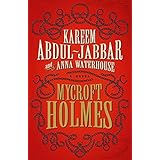
Mycroft Holmes by Kareem Abdul-Jabbar and Anna Waterhouse


A few weeks ago I was reorganizing my unread pile and discovered I had several books inspired by or otherwise related to the character of Sherlock Holmes. So I decided to make February a (mostly) Sherlock themed month. The third one in my queue was Mycroft Holmes by NBA star Kareem Abdul-Jabbar and Anna Waterhouse. In this Sherlock related book, the detective on the case is Sherlock’s older brother, Mycroft Holmes. 
 
Product DetailsMycroft’s friend, Cyrus Douglas and Mycroft’s fiancée, Georgiana Sutton both happen to be from Trinidad, though from different sides of the island. Both Douglas and Sutton hear rumors about mysterious deaths of children in their home country. Locals fear the killer is supernatural. Neither Douglas nor Georgiana believe the supernatural excuse, and for that matter, neither does Mycroft. Nevertheless, Georgiana immediately bolts for home, insisting that she must go alone and find out what's going on. Before Mycroft can stop her Georgiana is gone. Mycroft decides to follow her, convincing Douglas to go with him. Almost as soon as the two men set foot on the ship that is to carry them to Trinidad, Douglas and Mycroft are attacked. Someone doesn’t want them poking their noses around in Trinidad.

I read this book for character more than plot. I wanted to know more about Mycroft. Let me pause here and admit that I am no expert on the character of Sherlock Holmes. Although I have read about half of the original tales by Sir Arthur Conan Doyle, my frame reference comes primarily from the BBC series Sherlock. When I think of Mycroft, I think of Sherlock’s smarter, older brother with the non-specified but very important government job. Here, Sherlock isn’t yet brilliant and Mycroft isn’t yet very important. Mycroft is, however, much happier and well-adjusted than his younger brother. I mean, he’s engaged for goodness sake. Can you imagine Sherlock ever marrying? I think not.

My favorite part of Mycroft Holmes was Cyrus Douglas – a strong, smart Black man in 19th century England. He’s not Watson; he’s better. He is not as in awe of Mycroft as Watson is of Sherlock. Douglas has a life, a history, and a viable business apart from Mycroft. The two seem like equals in a way that Sherlock and Watson often don’t. In terms of plot, overall this was a pretty good mystery. If Abdul-Jabbar and Waterhouse right another Holmes and Douglas mystery I'd read it.