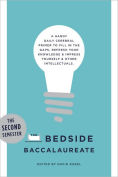
 Every morning for the last six or seven years I have begun my day by reading a page from an nonfiction book that explains how some aspect of the world and/or human history works. The idea is to improve one's knowledge and education on a certain subject or subjects. I started with a book called The Intellectual Devotional. That book became a series with devotionals focused on American history, modern culture, health, and biographies, each of which I devoted a year too. For a change of pace one year I found a devotional for book lovers called appropriately enough, the Bibliophiles Devotional. Each page (365 in total, one for each day of the year) was devoted to a literary classic. Having finished The Intellectual Devotional series, for 2015 I looked for another similar type book and found The Bedside Baccalaureate. Skipping the first book in the series, I decided to begin my mornings in 2015 with a page from The Bedside Baccalaureate: The Second Semester.
Of these type of books I've read, The Bedside Baccalaureate might be my favorite. It is divided into four sections or syllabi. Each syllabus consisted of five courses, for a total of twenty courses. Broadly speaking the courses covered topics in art, literature, the classics, math and engineering, social science, history, economics, physical science, religion, environmental science, and philosophy. I learned a little about the anatomy of the Internet, electricity and magnetism, the roots of the Cold War, the epics of the Trojan War, the Protest Reformation, Sigmund Freud, and Italian Renaissance art. My favorite courses were on game theory, issues in feminism, the 1913 Armory Show, meteorology and climate, the history of modern China, and the origins of Judaism. Some courses or topics I still don't understand. (If there was a test of electricity and magnetism I would absolutely fail). Some topics whet my appetite for more and led me down rabbit holes to find more information. (Who knew game theory would turn out to be so interesting?)
I really enjoyed my morning reading ritual this past year. (Who am I kidding, I enjoy it every year or I wouldn't do it.) These types of books are a great way to learn something knew without it feeling like you're back in school. The small chunks of information (just one page) keep it interesting and remove any iota of intimidation I might have about tackling a new topic, especially one having to do with science or engineering, two things I generally know little about. The Bedside Baccalaureate had the added benefit of being divided into four sections, which meant I didn't spend a whole year on the topics I enjoyed less.
Eventually, maybe in 2017, I will read the first semester of The Bedside Baccalaureate. For 2016, I'm going to switch things up and pick a nonfiction book from my way-too-big TBR pile. It won't be a devotional but something that hopefully I can divided into small chunks and read slowly. Hopefully it will be just as interesting and educational.

 The world is ending. An asteroid is set to collide with planet earth in six months or so. Some people choose to end their individual world prematurely with suicide. Others continue to hope for a last minute saving grace or take comfort in their religious faith. Some decide that if the world is ending they should make the most of what time they have left, whether that means traveling the world, spending time with loved ones, or taking drugs and smoking cigarettes because at this point there are no consequences tomorrow for today's bad choices. Still others continue to live more or less as they did before the idea of an asteroid colliding into the planet became a definite and certain reality. Police detective Henry Palace falls into the last category.
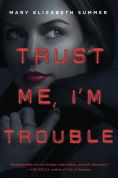 Trust Me, I'm Trouble is the second book in a series by Mary Elizabeth Summer about a young grifter who goes by the name Julep Dupree. It picks up not long after the events of the first book, Trust Me, I'm Lying, with Julep now living with a foster family and grieving over the loss of a friend. She's still taking on cases only now her client base extends beyond the halls of her private Catholic high school. When a woman asks for her help in finding out how her husband became an embezzler, Julep knows she should walk away. She doesn't of course, not even when it requires her to infiltrate a shady "leadership" organization. When her new case appears to be connected to her long lost mother, Julep is even more drawn in. Pretty soon it isn't clear who's the con and who's the mark.

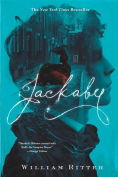 There's a blurb on the front cover of my copy of Jackaby that describes it as Sherlock Holmes crossed with the Buffy Slayer. Its two principle characters, R. F. Jackaby and Miss Abigail Rook are clearly inspired by Sherlock Holmes and there's enough of the supernatural thrown in to make the Buffy comparison fitting. Jackaby is the quirky detective who is always ten steps ahead of everyone else. His "Watson" is a young lady named Miss Rook. She has a thirst for adventure, having recently run away from home to chase dinosaurs and excitement. Miss Rook also has a talent noticing the ordinary and deducing details about a person or a situation, much like the legendary detective. Jackaby, in turn, has a talent for noticing the extraordinary. Of course, most of the townspeople think Jackaby is mad, or at least a little odd. It doesn't help that he has tendency to speak bluntly and without tact. Miss Rook is warned more than once against taking a job as Jackaby's assistant. But newly arrived in New Fiddleham and short on funds, Miss Rook can't afford to turn down the job. Even better, she finds she quite enjoys it! How could she not when her first mystery brings her fact to face with a banshee, a goblin, and other mystical creatures.
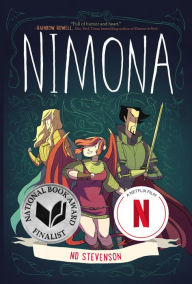 Nimona shows up at the villainous Lord Blackheart's door, volunteering to be his new sidekick and help him defeat his arch nemesis Sir Goldenloin and the Institution of Law Enforcement. Adventure ensues. Bad guys end up having more good in them than bad. Good guys turn out to be less heroic than expected. There's friendship, science and a dragon!