Monday, December 22, 2014

The Joy and Agony of Reading Challenges, or, Why I Keep Doing Reading Challenges Even Though They Drive Me Crazy


Reading challenges always seem like a good idea in January.  So good that in 2014 I signed up for four: (1) the Goodreads reading challenge, (2) a genre challenge that involved reading 36 books from 36 different genres, (3) a title challenge where the goal was to read books that included a reference to time, royalty, weather, name or forename or number written in letters in the title, and (4) a TBR challenge.

With only five categories, the title challenge was short and sweet and the TBR challenge was about reading books I already own so any book counted so long as it was something I owned prior to January 1st.  The Goodreads reading challenge turned out to be less challenging than expected.  In fact I upped my goal twice, settling on 90 books and still surpassed that.  This was in part because I read several graphic novels which being more pictures than word, were easy to get through quickly.  The genre challenge is what nearly drove me to the edge.  

Like the Goodreads reading challenge, the genre challenge had statistics to tell me when I was ahead or behind on my goal. Around October when I still had several genres to go, I started doubting whether I would finish.  I started dreaming about December 31 when all challenges would come to an end.  For a moment I contemplated going into 2015 with no challenges at all.  Two things made me reconsider.  First, I discovered new challenges and as always found several that sounded too fun to pass up.  Second and more importantly, for the first time I attempted to analyze what and who I read over the past year

I have always thought of myself as an eclectic reader.  When anyone asked what type of books I liked my go-to response was everything except horror.  (I am not a fan of gore.)  True enough, I read mysteries, romances, science fiction and fantasy, as well as general and literary fiction.  I read classics and contemporary, and some non-fiction.  I thought my reading was pretty broad.  Then in 2013 I came across my first genre challenge and it turned out my reading wasn’t as broad as I thought.  Thanks to the genre challenges I discovered genres I had heard of but had never read before (steampunk), had barely read before (graphic novels and poetry), and hadn’t even known existed (cyberpunk).  I read my first western and am slowly working my way through Shakespeare.  This isn’t to say every genre was a joy to read.  Horror is still a mixed bag for me and true crime is a struggle (love murder mysteries but less so when the murder is real).  Through participating in the genre challenges (I participated for a second time in 2014), my reading became much more broader than it had been before.   

After broadening my reading in terms of genre, the next step is to broaden my reading in terms of nationality and ethnicity.  In analyzing what I read I found that the overwhelming majority of books I read in 2014 were written by Americans with the occasional Brit or Canadian thrown in.  A few were by African-American and Latino or Hispanic American authors, but not by authors from an African, Central American or South American nation.  I did not read any books by Asian or Asian-American authors this year.  For this reason I created a new challenge for myself that I’m calling Reading the World in 2015.  The goal is to read one author from a nation in each of the following regions: Asia, Africa, Central or South America, North America (not including the United States), Europe (not including the United Kingdom), and Oceania, plus books by Asian-American, African-American, and Latino and/or Hispanic-American authors.  Of course, I could just tell myself to read more diverse books but that seems like making a vague New Year’s resolution.  While by no means a guarantee, I find that specificity tends to work better when it comes to getting things done.  Reading challenges are specific.

At times the challenges can be frustrating.  Truthfully, sometimes challenges make me feel like I have to read a particular book when I would rather read something else.  At some point in 2015 I will inevitably wonder why I signed up for any challenges.  I will also (hopefully) discover something that is interesting and new.  This is why I keep taking on reading challenges.  Strange as it may sound, I am grateful for being forced to read something that normally wouldn’t be on the top of my TBR pile.  Reading challenges are part goal and part aspiration.  I might not reach my goal but I keep trying to get there.  As for those Goodreads statistics that tell me how good or how bad I’m doing, when I see them I think, “Yea me, I’ve totally got this,” or “I fell off the wagon but it’s not too late to get back on,” or “forget it, time to rethink this.”  I use the statistics to motivate me and keep me on track.  More importantly, the challenges help me be the eclectic reader I’ve always claimed to be. They keep me honest.


Wednesday, December 17, 2014

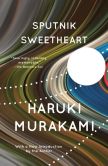
Sputnik Sweetheart by Haruki Murakami

Sputnik Sweetheart  The first book I read by Haruki Murakami was What I Talk about When I Talk about Running.  I like running and reading about running and he wrote about running so it was perfect.  I really liked it and vowed to read more about this author I had heard so much about.  Being a sucker for a well-done media campaign, when 1Q84 was published I ran out immediately and bought it and then didn't read it.  I meant to but was a little intimidated, less because of its size and more because of way people talk about Murakami.  It just felt like a Murakami book was going to be an experience that had to be prepared for.  Also, everyone seemed to advise against starting the Murakami experience with 1Q84.  Seriously do a Google search for "where to start with Haruki Murakami" or something similar and 1Q84 will never be the answer.  The next Murakami book I picked up was The Strange Library but the consensus seemed to be that it was not the best place to start either.  Instead the consensus suggested starting with Norwegian Wood, but a friend suggested starting with Sputnik Sweetheart, so that's where I started.

I’m not sure how or what to think about it yet.  Let’s start with the writing.  I loved it.  This will sound weird but fifty pages in I began thinking that this book was like warm butter melting over freshly baked, still warm bread.  I often read in short spurts.  Twenty minutes here then I’m doing something else, then maybe another ten minutes reading later.  Yesterday I got in a couple pages while waiting for a meeting to start.  I picked up Sputnik and the next thing I knew I was 100 pages in.  Hardly anything could distract me from Murakami's writing.  It flowed and melted into my psyche with hardly any effort.

According to the description on the book’s back cover, Sputnik is a love story combined with a detective story.  I’m not sure I would call it that.  There are characters who express degrees of love for another.  Actually there is a love triangle, or not quite a triangle since all the sides don't connect up.  The narrator is in love with a former classmate called Sumire.  For a long time Sumire says she does not quite understand love or sexual desire but then she falls in love with an older woman called Miu.  Miu doesn't love, can’t love anyone anymore.  The mystery portion of the story begins when Sumire disappears while visiting a Greek island.  Efforts are made to find her but it takes more than that to make a detective story. 

Rather than a mystery or a romance, to me this read like an exposition on loneliness and disconnection.  When Sumire and Miu first meet Miu essentially asks Sumire what about her makes her special and what it is she does.  Sumire doesn’t have a much an answer other than she aspires to be a writer.  Although she writes daily Sumire doesn’t really have much to say yet.  Miu offers Sumire a job, suggesting that perhaps she needs a bit more life experience.  Miu is beautiful, sophisticated and worldly.  It is no wonder why Sumire falls for her.

Sumire and the narrator have been friends a long time.  Like Sumire, he is somewhat removed from life.  In one of my favorite passage the narrator notes that his passions are books and music and that there is barrier between him and other people.  The one person he cares deeply about is Sumire.

Later in the story Sumire via the narrator recounts a story Mia told Sumire about an experience she had fourteen years earlier.  The experience turned her once black hair completely white and left her an empty shell unable to fully connect with the world in the way she used to.  That was what stuck out to me the most – how all three characters were connected and disconnected from each other, themselves, and other people.

It is times like this when I almost wish I was back in school so I could take a class and discuss this book.  In any case, I’m glad I finally read a Murakami book.  1Q84 is probably going to remain in a TBR pile a bit longer but I’ll get there, eventually.  Before that I'll try The Strange Library and Norwegian Wood. 

Sunday, December 14, 2014

Sweet Filthy Boy by Christina Lauren

Sweet Filthy Boy  Based on the timing of what books are published when and the accompanying news stories and marketing campaigns, during the summer you're supposed to read romance, action thrillers or whatever else is short, fun, and easy.  Fall marks the beginning of the serious reading season.  It's when the big books, the ones likely to be nominated for prestigious awards tend to get published.  I tend to read in the opposite way.  During the summer when I have more free time and especially when I'm on vacation, I pick big books.  During the winter, especially at Christmas I read mysteries and romances.  With all the busyness of the holiday season and finals (I work at a university), it is hard for me to get into a complicated story.  This is largely why I picked up Sweet Filthy Boy by Christina Hobbs and Lauren Billings, the writing duo that goes by Christina Lauren.   I needed something light and fun and this definitely fit the bill.

Living up to its name, this read was definitely sweet and filthy.  It begins with three girlfriends celebrating their graduation from college with a trip to Vegas.  The three girls, Mia, Harlow and Lola meet three boys: Frenchman Ansel, Australian Oliver and Canadian Finn.  After a night of hard partying the three girls wake up married to the three boys.  Harlow, Lola, Oliver and Finn sober up the next morning and wisely line up to get annulments immediately.  Ansel meanwhile refuses to give Mia an annulment.  He tells her that when they got married Mia made him promise not to get an annulment at least until the summer ends.  Mia remembers barely anything from the night before but decides to go with it, confident she'll be single by the time graduate school begins in the fall.  She plans to pursue an MBA at Boston University, or rather Mia's father plans for her to pursue an MBA.  Mia returns to her parents home and prepares to start the next phase of her life as planned.  After a few horrible days with her parents, Mia decides to throw caution to the wind and spend the summer in Paris with her new "husband."  This is a romance so you know where this heading.  There is some awkwardness, some misunderstandings, lots of sex, and eventually they fall in love.  It was all very hot, very sweet and plenty filthy - the perfect read for the busy holiday season.

Thursday, December 11, 2014

Thoughts about Reading Challenges and Reading Goals in 2015


In 2014 I took on four reading challenges.  It was fun but also a little frustrating at times.  Part of me doesn’t want to do any challenge except for the Mount TBR challenge (discussed later).  Challenges add pressure to conform to a predetermined course of reading.  During that past year I sometimes felt that I had to read something to meet a challenge, rather than reading what I want.  On the other hand, broadening my reading horizons is a definite goal.  The Literary Exploration genre challenge has been instrumental in doing that over the past two years.  Steampunk is one example of that.  I had been aware of steampunk as a literary genre but hadn’t read any of it until I did the first Literary Exploration challenge. 

Another way I would like to broaden my horizons is in terms of the background of the authors.  I did an analysis of what I read in the past year (so far) and found that about 59% of the authors were female and 41% were male.  In terms of nationality, two-thirds of the authors were American.  British authors came in a distant second, and Canadians third.  I would really like to read more non-American authors.  In terms of age groups, I wondered if I was reading too much young adult and new adult fiction.  Young adult fiction is great but I don't want to miss out on adult books either.  Turns out  that while I have been reading a lot of young adult (and new adult) fiction lately, those categories made up only 22% of my reading, while adult fiction and non-fiction made up 70%.  The remainder consisted of children’s books and books I characterized as aimed at any age.

Wednesday, December 3, 2014

Excavation: A Memoir by Wendy C. Ortiz

Excavation: A Memoir 

Excavation is Wendy Ortiz’s memoir about her “relationship” with Jeff and a portrait of growing up in California’s San Fernando Valley in the 1980s.  When Wendy and Jeff started “dating” she was a thirteen-year-old student in the eighth grade; he was her twenty-eight-year-old teacher.  I put “dating” and “relationship” in quotes because it is hard for me to think of the five years they spent on and off together as anything other than sexual assault.

Wendy’s parents were alcoholics, especially her mother, or maybe not especially her mother.  After her parents separated her father became less involved in Wendy’s life so Wendy’s mother drinking is more visible than her father’s.  Another thing that stood out was that her family was very bookish.  Wendy describes scenes when her mother would be in one room reading, her father would be in the living room with a sports game on TV but really reading a book more than watching the game, and Wendy would be in her room reading or writing.  Writing was a big part of Wendy’s life from a young age.  At age thirteen she was already working on a novel.  I wonder how much, if at all, her literary outlets are part of what helped Wendy to get out of the relationship and away from Jeff.  Through all her years with Jeff, during which there was a fair amount of drinking and drugging by Wendy and the people around her, Wendy kept writing, kept reading, and kept getting good grades in school.  

There is a passage early in the book and early in their relationship when Jeff is telling Wendy how smart she is and how he is going to help her get to college.   Reading it, it is clear he is trying his best to sweet talk her into bed, but what’s great about that scene is when Wendy thinks to herself, of course I’m going to college.  Even at age thirteen she had a strong enough sense of herself and what she was capable of.   She never seemed to lose sight of that.  One of the things this memoir makes me think of the kids who don’t have a goal like college.  I suspect that because Wendy had a talent for writing at a young age and that she expected to go to college, she sort of had a built in way out.  Despite what was happening to her, there was a good chance she would get way from Jeff by growing up and going to college.  What happens to kids who don’t have that sense of a future, who cannot quite imagine life beyond high school and the neighborhood where they live?

This short memoir left me with a ton of questions, like:

  • Before Jeff Wendy was curious about girls and boys.  At the end of the book she’s in a committed relationship with a woman and they have a child and I wondered how that came about.  I also wonder if in some way her relationship with Jeff an unconscious attempt to force herself into being in a heteronormative relationship even if that is not really how she felt.  Put another way, did societal rejection of non-heterosexual relationships (at that time) make her more susceptible to a predator like Jeff?
  • How and when did she come to view her relationship with Jeff as abusive?  Throughout the book she thinks of him as her lover, boyfriend, and friend – when did that change?  Basically I wonder how she got from point A, young girl in a sexual abusive relationship with a much older man, to point B, healthy adult woman in a committed relationship and who has a great career as a writer?
  • During her adolescence Wendy’s parents seemed to be largely oblivious to what was going on in their daughter’s life.  How did her parents react when they either read her memoir and/or otherwise found out about what happened to their daughter while she was living under their roof?  Are they still drinking?
  • On the back cover of the copy of the book I read it says Jeff is now a registered sex offender but there is nothing in the book describing how that happened.   There’s no mention of Jeff seducing and sleeping with other underage girls but you just know he did.

One of the strongest chapters in the book is when Wendy describes why she didn’t tell.  She writes,

 “I didn’t want to be average. I didn’t want it to end.  I was comfortable keeping secrets.  I felt responsible for his acts.  I was numb…The truth is I did tell.”

The list goes on and by the end you get a sense of how difficult it is to be in and get out of a situation like this, but also how difficult for outsiders to help.

Excavation is one of those books that kept popping on my radar.  I cannot remember where I first heard about it but it seemed to be everywhere so I put in a request at my library and waited for it to arrive.  Once it did and I started reading it and never wanted to stop.  The only reason I didn’t finish it in one day was because I was exhausted from driving in rain soaked traffic and had to get some sleep.  (It doesn’t rain much where I live but now were getting soaked which is good except for the driving part.)  I would recommend this to just about everyone.  It is a very quick read and draws one in quickly.  Wendy’s writing paints a vivid picture of growing up in Los Angeles and growing up generally without sentimentality.  She throws in bits about her adult life so you get a glimpse of the woman she has become.  I don’t know what else to say except that I was captivated.


Tuesday, December 2, 2014

Challenge Update

In 2014 I took on four reading challenges:
  • the Literary Exploration challenge where the goal was to sample thirty-six different genres;
  • Mount TBR where the goal was to read books I already owned and make the mountain a little smaller;
  • the What's in a Name? Challenge, a whimsical challenge where one reads books with titles that meet certain random criteria; and
  • a general Goodreads challenge to read 65 to 70 books within a year.

Monday, December 1, 2014

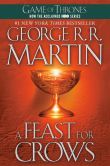
A Feast for Crows by George R.R. Martin

A Feast for Crows (A Song of Ice and Fire #4) A Feast for Crows (AFFC) is the fourth book in George R.R. Martin's A Song of Ice and Fire series.  The series started with A Game of Thrones (AGOT).  It was a fascinating read that pulled me into the world of Westeros pretty quickly.  A Clash of Kings (ACOK) was a slog to get through.  Seriously, it was painful at times.  Then came A Storm of Swords (ASOS), my favorite book in the series so far.  There was one surprise after another and the ending tied a lot of story lines together.  If I were to rank the books in the series so far, ASOS and AGOT would come in as a close number one and two, ACOK would be a very distant fourth.  AFFC would come in at number three.  It is much better than ACOK but was a let down after ASOS.

The biggest let down is that several of my favorite characters are missing in action in AFOC.  The Ice and Fire series is told from the points of view of multiple characters, with each chapter focusing on one character and his or her experiences at a time.  My favorite characters include Arya, Tyrion, Jon, Samwell, and Bran.  Tyrion, Jon, and Bran are completely awol this time around.  Arya only has a few chapters.  Samwell has five, but it wasn't enough.  I even missed Daenerys and usually I find her chapters entertaining but too removed from the rest of the characters.

Instead of my favorite characters there were chapters from Cersei, Jamie, Brienne, and a handful of new and random characters.  Cersei, the Queen Regent, is not at all sympathetic character but as the book went on it was interesting to see her thought process.  I liked Jamie's chapters in ASOS and here in AFOC.  In the first book the Lannisters, especially twins Cersei and Jamie seemed inseparable and intent on increasing their power and wealth at any cost.  By the end of ASOS and through AFFC, the roar of the Lannister lions is not quite the same as it once was.  Brienne's chapters are repetitive: she's on a mission to find Sansa and is failing at it, repeatedly.

Overall, AFFC felt like being put on hold, like when I've been put on hold on the phone or am waiting in line somewhere.  In the background on the phone or in the office there's music playing.  Sometimes the music is awful, a bastard version of a once popular song or just some crap that makes me feel like my ears are being assaulted.  Other times the music is pretty good and I find myself moving a tiny bit to the beat even though I might be in public.  I'm still waiting but the music makes the wait more bearable.  I might even temporarily forget that I'm being kept waiting.  Martin was clearly laying the groundwork for something with AFFC.  I knew I was being kept waiting, but the wait wasn't too bad.